At the end of November last year, I gave up taking the subway. A few reasons. I’d just returned from a six-month trip to India and being confronted with the same grim faces on that underground steel coffin brought home to me the fact that I was… well… home. And being back here, how profoundly not at home I felt again in New York City.

Of all the tedious rituals of city life to return to, the subway was the most dispiriting. It starts with the descent into those airless caverns, and only gets worse, at least for me. I hate waiting. In fact, hate is too mild a word. I abhor it, I vilify it, if I met Waiting in a dark alley in the middle of the night, I would do my best to snap its ugly neck. There is something deeply infantilizing about the long (or short) waits we have to endure before the train arrives, for here we become wards at the mercy of the Metropolitan Transit Authority, the unloved orphans it consumes daily and who must always bow to its caprices, begging, “Can we please just get on your train, sir?” Maybe the train arrives within thirty seconds, and we find ourselves thankful for the wretched crumb of timeliness thrown at our feet, or maybe we wait a quarter hour, or even longer, staring down at the devastated concrete that floors these torture chambers of the modern world, if only so as not to look at the devastated faces surrounding us, in the mornings ejected unhappily from their beds, in the evenings ejected exhausted from offices.

In and of itself, the wait seems reasonable. The subway is a public good, it provides the infrastructure to move millions of people every day, and keeps a city like New York from grinding to a halt. And it’s good for the environment, and for health, and nominally, there’s a democratic spirit at work. We’re all in it together underground, a bit of London in the Blitz transported westward. But as one wait piles on another, as one line is added to another, those dreary, stifling minutes underground become intolerable. For the modern city, that compacted horizon of lives stratified, one on top of the other, each crushing the one below, finds its condensate on those lonely platforms and inside those deadening train cars. The city, if it is anything, is a dirge of choruses all of them memorializing “the wait.” The wait at the stop light, the wait for the elevator, the wait in the lunch queue, the wait on the phone for customer service, the wait for the delivery man, the super, the cable guy, the wait at the laundromat, the wait for a table for dinner, the wait at a bar for the barkeeps’ eye, the wait for the sorely underpaid cashier to acknowledge your existence, the endless wait for the city to do the same.
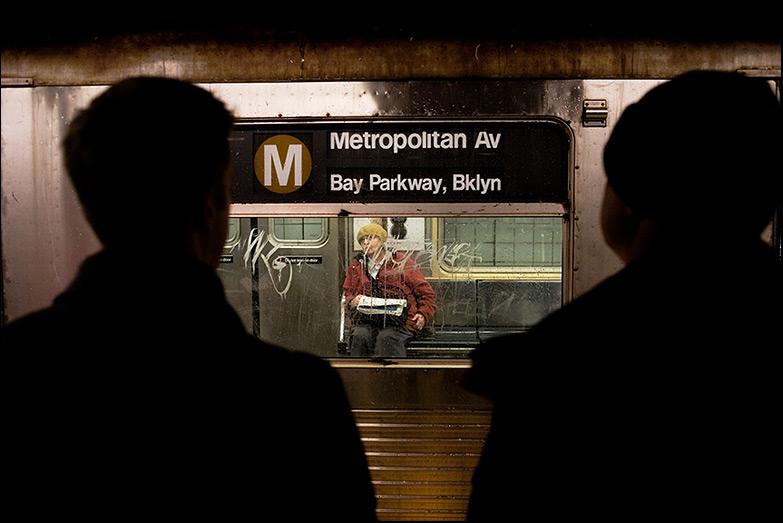
And once you’re on the train, it gets no better. For inside, you sit or stand, carried along powerlessly, literally shuttled back and forth underneath the city, not even blood in its arteries, for blood has a vivifying function as it pumps along. Inside the train, you become a null, a being waiting again to arrive, as if you have been murdered and await resurrection as a zombie. We become children once again, ruled by the whims of an unknowable and towering parent, powerless in its presence, and all around is the evidence, the faces of the fellow travelers reduced to ashen replicas, their nearest counterparts the democracy of bodies turned to stone in Pompeii. If this is democracy, it’s democracy of lives lived in hell, it’s democracy of the coming apocalypse, it’s democracy stripped of soul, of breath, of anything that might be imagined as human, a cudgeling, murderous reduction of city dwellers to cave dwellers, and cave dwellers to the newly dead.
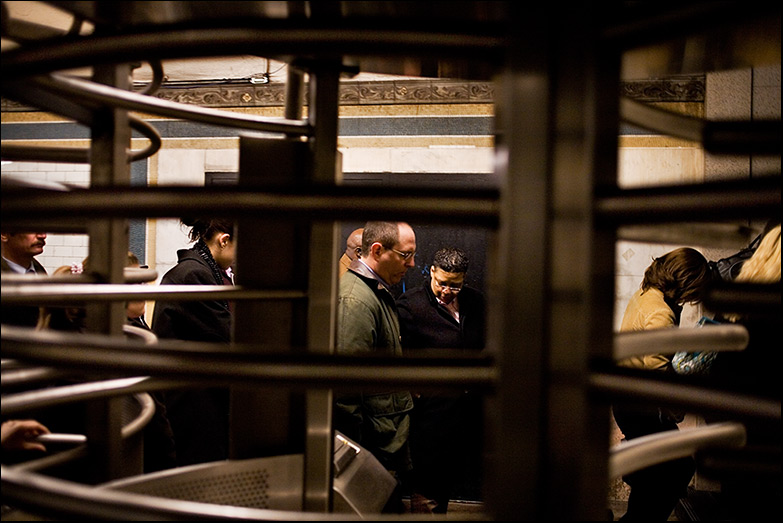
Perhaps I’m laying it on a little thick. People do take the subway, sometimes they smile, sometimes they laugh, and most of them arrive on the other side apparently alive. And without it, the lives of the vast majority of people in this city would become intolerably difficult. But with it too, I believe, life becomes intolerable. When millions are forced, on a daily basis, through the meat grinder that is the subway, year in and year out, what else can it do but make ghosts of us, demoralized and hypnotized by an industrial ideal of the efficient city and its proper functioning.
All these incredible images by Travis Ruse.
 RANBIR SIDHU